
From measurement chart to pattern block
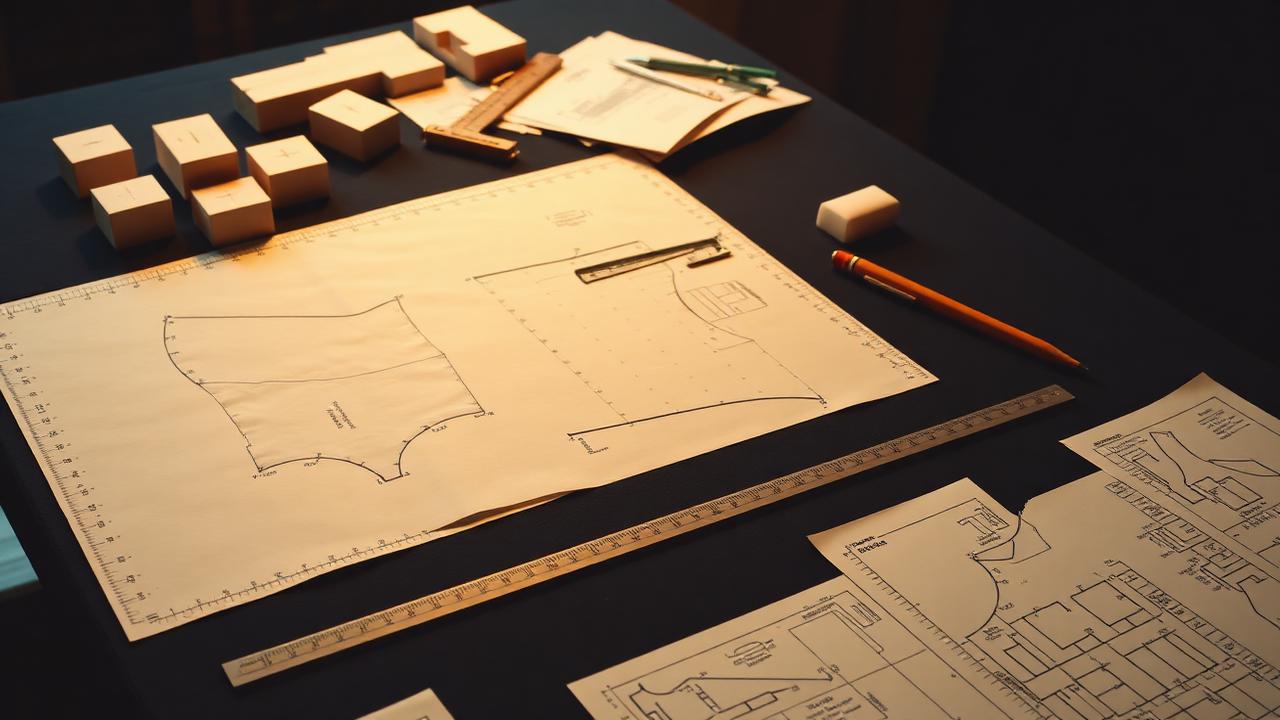
A pattern is a translation. Body measurements plus wearing ease plus design ease produce garment measurements, and the block is the geometry that delivers them. When a fit comment repeats sample after sample, the translation step is usually where it went wrong.
Every service, study and product on NOSK.life is free of charge — we never take a single penny from anyone.
How it works
1.Fix the base body
Choose the size chart and the base size, then confirm whether measurements are body or garment. Mixing them is the single most common cause of a first sample that is one full size out.
2.Add ease deliberately
Wearing ease keeps the garment usable; design ease creates the silhouette. Document both separately so a fit change never quietly removes movement allowance.
3.Draft and balance the block
Balance front and back, check armhole to sleeve crown ratio, and confirm side seam length equality. Walk every seam pair before printing.
4.Grade to the size range
Apply grade rules per point, not per panel. Girth grows around the body, length grows along the centre lines, and the armhole and neck get proportional shares.
Quick reference
- Typical girth grade
- 4–5 cm per size on tops
- Sleeve crown to armhole ease
- 1–2 cm on wovens
- Measurement tolerance
- ±0.5 cm on critical PoMs
- Base size choice
- Mid-range size of the sold curve
Checks you can run this week
- Walk every seam pair on the pattern before releasing to sampling.
- Confirm notches, grain lines and piece counts on each pattern piece.
- Record the ease table with the tech pack so fit changes stay traceable.
Free downloads for this topic
Print-ready A4 PDF sheets from the NOSK.space garment media library — free of charge, no sign-up.
Basic bodice block template
Front block outline with centre-front grain line, shoulder and side seam labels, and a seam allowance table for shoulder, armhole, neck rib and hem.
Set-in sleeve template
Sleeve head and cuff sheet with the shoulder-point notch, single front notch, double back notch and ease guidance for woven shirts.
Free studies and toolkits that use this
This explainer supports the following NOSK.space learning paths and toolkits — all free of charge, with no payments and no paywalls.
Free toolkit
Garment Calculator SuiteConsumption, efficiency, costing and capacity calculators covering everyday production maths.
Real contacts for this topic
Factories, mills, suppliers, buyers and industry bodies from the free NOSK.space garment directory that work directly with from measurement chart to pattern block. Every detail below is published on the organisation's own site and each link opens that site — free of charge, no introductions sold, no commission taken.
Lectra
Paris · France
CAD pattern making, marker making and automated cutting
- Address
- 16-18 rue Chalgrin, 75016 Paris, France
- Phone
- +33 1 53 64 42 00
SHIMA SEIKI
Wakayama · Japan
Computerised flat knitting machines and whole-garment knitting
- Address
- 85 Sakata, Wakayama-shi, Wakayama 641-8511, Japan
- Phone
- +81 73 474 8210
Shahi Exports Pvt. Ltd.
Bengaluru · India
India's largest apparel exporter — knits, wovens and fabric processing
- Address
- Bellandur Gate, Sarjapur Main Road, Bangalore 560 102, Karnataka, India
AEPC — Apparel Export Promotion Council
New Delhi · India
Official apparel export promotion body of India
- Address
- A-223, Okhla Industrial Area, Phase-1, New Delhi 110020
- Phone
- +91 11 40501798
Where this fits in sourcing
This topic is used at the following stages of the free NOSK.space sourcing guide, which links each decision to the questions to ask and the real organisations to approach.
- Stage 2: Pattern, marker and fabric consumption
Know your real fabric cost before you negotiate a garment price.
Common questions
- Should I grade before or after the fit approval?
- After. Grade only the approved base pattern, otherwise every fit correction has to be repeated across the full size range.
- Is the pattern content free?
- Yes — every study, guide and explainer here is free of charge, with no fees or subscriptions.
Finished this explainer?
Tick it off to track your own progress in the free student portal. It is stored on this device only — no login, no account, no fees.
Jobs this knowledge leads to
Real garment industry roles that hire for exactly this skill, with the employers that recruit them. Free to browse — no fees, no commission.
Pattern, CAD & sampling · Mid level
Pattern Maker
Turns the measurement chart and tech pack into a block, then grades it and proves it on a sewn sample.
Open the role guide
More free media
- Marker efficiency: where fabric cost is really decided
How marker planning, spreading and ply management move consumption by several percent — and what that means per order.
- Woven vs knit: how fabric construction changes everything
Warp and weft versus loops and courses — why the same fibre behaves completely differently once it is woven or knitted.
- How to read a fabric test report without guessing
GSM, shrinkage, colour fastness, pilling and tensile results — what each line means and which failures actually stop production.