
Marker efficiency: where fabric cost is really decided
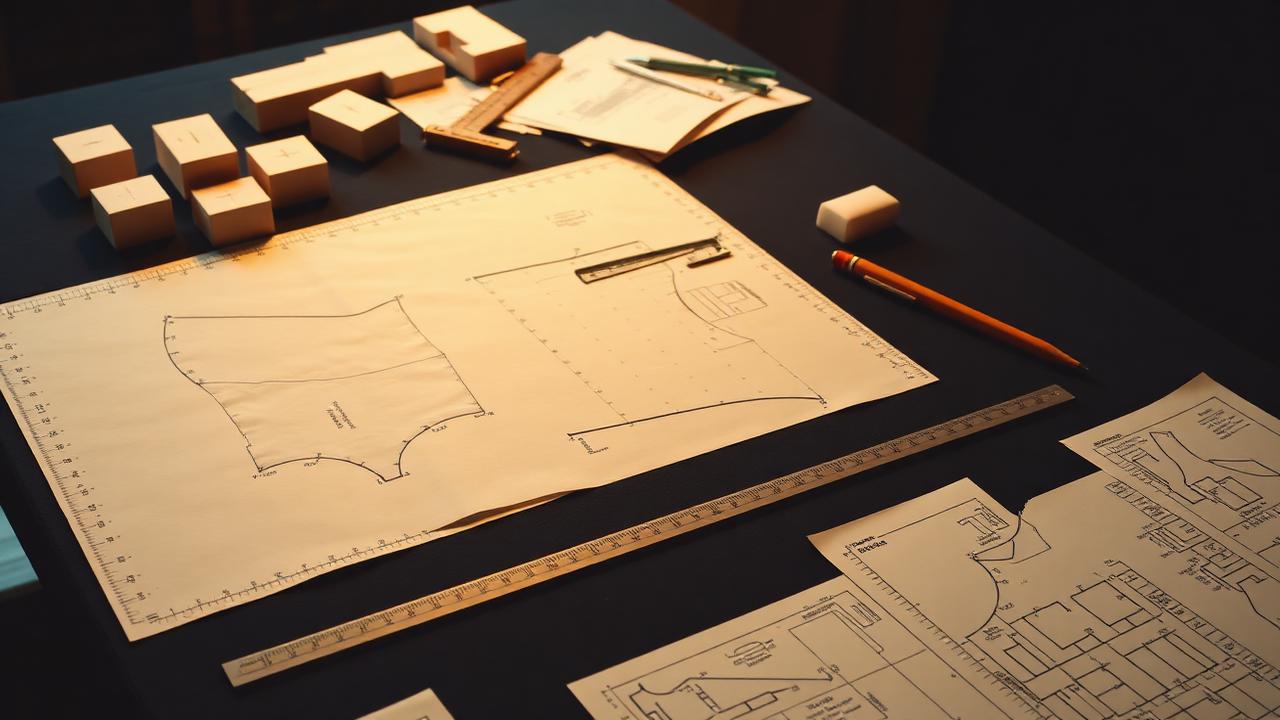
Cutting is where fabric is spent. A two-point gain in marker efficiency on a 50,000-piece order can pay for an entire cutting room upgrade, so marker discipline is a costing activity, not a technical afterthought.
Every service, study and product on NOSK.life is free of charge — we never take a single penny from anyone.
How it works
1.Build the size ratio
Combine sizes so large and small pieces nest. Mixed-size markers usually beat single-size markers by 2–4% because gaps get filled by smaller panels.
2.Respect the constraints
Grain direction, one-way prints, nap, stripe matching and splice points all reduce freedom. Record them on the marker so the operator cannot silently override them.
3.Control the spread
Tension-free spreading, correct ply height and edge alignment protect the efficiency the marker promised. A stretched ply cuts undersized panels.
4.Measure actual consumption
Compare planned consumption per garment against actual roll usage per lay. The gap, not the plan, is your real cost.
Quick reference
- Good woven marker efficiency
- 82–88%
- Good knit marker efficiency
- 78–85%
- Typical end loss allowance
- 1–2 cm per lay end
- Splice overlap
- 2–4 cm depending on panel
Checks you can run this week
- Audit five recent lays: planned vs actual consumption per garment.
- Verify relaxation time for knits before spreading.
- Check that every marker prints its efficiency value on the header.
Free downloads for this topic
Print-ready A4 PDF sheets from the NOSK.space garment media library — free of charge, no sign-up.
Patch pocket & press card template
Pocket outline plus a net-line press card so every pocket in a bundle is pressed to the same shape, with topstitch and bartack notes.
Free studies and toolkits that use this
This explainer supports the following NOSK.space learning paths and toolkits — all free of charge, with no payments and no paywalls.
Free learning · Advanced
Lean Six Sigma for ApparelDMAIC applied to real sewing-floor problems, with statistical tools sized for factory data.
Free learning · Intermediate
Sustainable Manufacturing EssentialsMaterials, water, energy and circularity — measurable sustainability for production teams.
Free toolkit
Garment Calculator SuiteConsumption, efficiency, costing and capacity calculators covering everyday production maths.
Free toolkit
Factory KPI Dashboard KitDefinitions, data-capture forms and dashboard layouts for the twelve KPIs that actually move output.
Real contacts for this topic
Factories, mills, suppliers, buyers and industry bodies from the free NOSK.space garment directory that work directly with marker efficiency: where fabric cost is really decided. Every detail below is published on the organisation's own site and each link opens that site — free of charge, no introductions sold, no commission taken.
Lectra
Paris · France
CAD pattern making, marker making and automated cutting
- Address
- 16-18 rue Chalgrin, 75016 Paris, France
- Phone
- +33 1 53 64 42 00
Arvind Limited
Ahmedabad · India
Denim, woven shirting and garment manufacturing
- Address
- Naroda Road, Ahmedabad 382 345, Gujarat, India
- Phone
- +91 79 6826 8000
- investor@arvind.in
Epic Group
Hong Kong · Hong Kong SAR (plants in Bangladesh, Vietnam, Ethiopia, Jordan)
Multi-country apparel manufacturer and sourcing group
DBL Group
Dhaka · Bangladesh
Vertically integrated knitwear manufacturing, spinning, dyeing and printing
- Address
- South Avenue Tower, House 50 (6th Floor), Road 3, Gulshan Avenue, Dhaka 1212, Bangladesh
Where this fits in sourcing
This topic is used at the following stages of the free NOSK.space sourcing guide, which links each decision to the questions to ask and the real organisations to approach.
- Stage 2: Pattern, marker and fabric consumption
Know your real fabric cost before you negotiate a garment price.
- Stage 3: Cost estimation and quotation build-up
Rebuild the quoted price line by line so you know what you are actually paying for.
Common questions
- Why does actual consumption exceed the plan?
- End loss, splices, roll-to-roll width variation, fabric faults and re-cuts. Track each cause separately or you cannot fix any of them.
- Do you charge for the calculators used here?
- No. The calculators and every resource on NOSK.life are free of charge, always.
Finished this explainer?
Tick it off to track your own progress in the free student portal. It is stored on this device only — no login, no account, no fees.
Jobs this knowledge leads to
Real garment industry roles that hire for exactly this skill, with the employers that recruit them. Free to browse — no fees, no commission.
Pattern, CAD & sampling · Mid level
Pattern Maker
Turns the measurement chart and tech pack into a block, then grades it and proves it on a sewn sample.
Open the role guidePattern, CAD & sampling · Entry level
CAD / Marker Planner
Makes the markers that decide fabric cost — usually the single largest controllable cost in the garment.
Open the role guideMerchandising & costing · Entry level
Merchandiser
Holds the order together from enquiry to shipment: costing, consumption, approvals, trims, dates and buyer communication.
Open the role guide
More free media
- From measurement chart to pattern block
How ease, tolerances and body measurements turn into a first pattern — and where fit problems are actually created.
- Woven vs knit: how fabric construction changes everything
Warp and weft versus loops and courses — why the same fibre behaves completely differently once it is woven or knitted.
- How to read a fabric test report without guessing
GSM, shrinkage, colour fastness, pilling and tensile results — what each line means and which failures actually stop production.