
Seam types and stitch classes used in real production
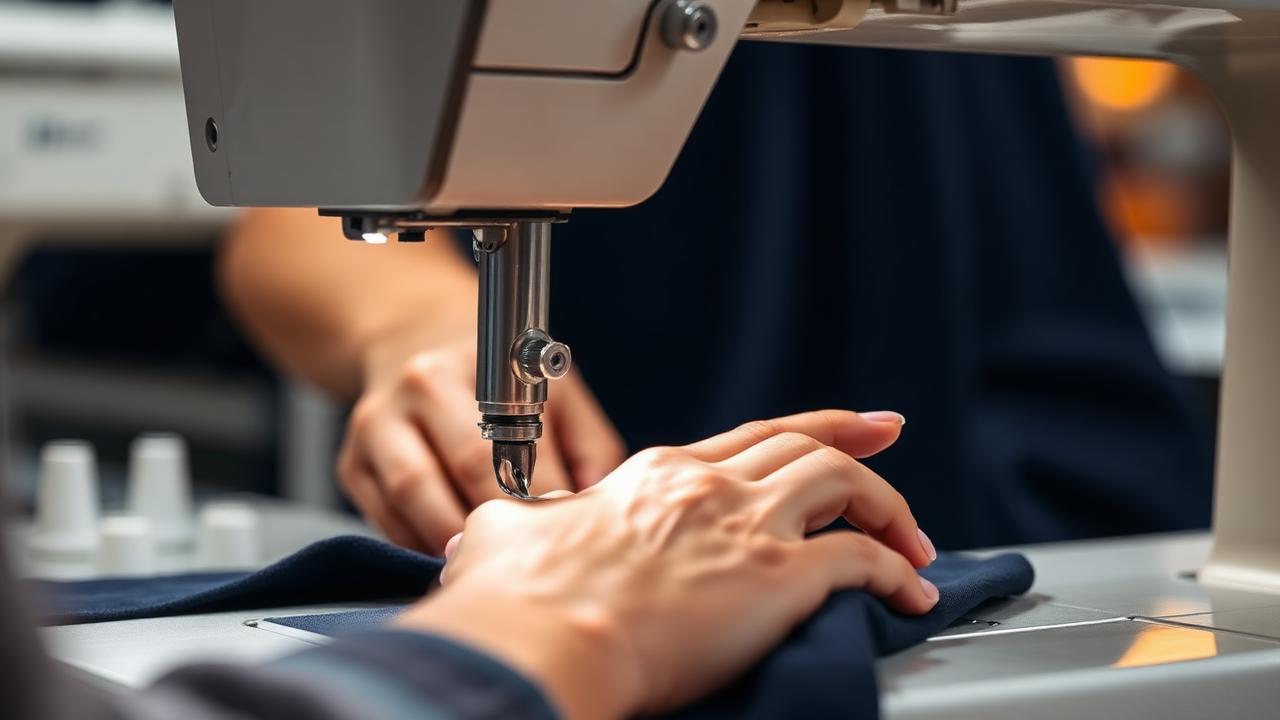
A tech pack seam code is an instruction to the sewing floor: it fixes how many plies meet, how they fold, which stitch holds them and which attachment guides them. Reading seam and stitch codes correctly is the difference between a plan that runs at target efficiency and a line that reworks all day.
Every service, study and product on NOSK.life is free of charge — we never take a single penny from anyone.
How it works
1.Read the seam class first
Superimposed (SS) joins two plies face to face; lapped (LS) overlaps them, as on a jeans side seam; bound (BS) wraps a raw edge; flat (FS) butts two edges together; edge finish (EF) folds a single edge, as on a hem.
2.Match the stitch class to the load
Class 301 lockstitch for stable wovens and topstitching, 401 chainstitch for stretch and long seams like inseams, 504/514 overlock for knit joins and edge neatening, 605/607 flatlock and coverstitch for flat knit seams and hems.
3.Add the folder, guide or attachment
A lapped seam without the correct folder becomes a hand-guided operation: slower, wider variation and puckering. Most seam quality gains come from correct folders, edge guides and feed settings — not from operator effort.
4.Prove it on a sew-by sample
Before bulk, sew one panel per seam with the exact machine, needle, thread and folder. Measure SPI, seam width, seam strength and appearance. That sew-by becomes the line's reference, on the machine, for the whole order.
Quick reference
- Lockstitch (301)
- Stable wovens, topstitch, 10–14 SPI
- Chainstitch (401)
- Stretch seams, inseams, high extension
- Overlock (504/514)
- Knit joins and edge neatening
- Coverstitch (602/605)
- Flat hems and flat knit seams
Checks you can run this week
- Confirm every tech pack seam code has an assigned machine, needle and folder before the line is laid out.
- Measure SPI on three points of each critical seam, not just at the start.
- Test seam strength and extension on knit shoulder and crotch seams before bulk.
- Keep the approved sew-by sample at the workstation for the full order.
Free downloads for this topic
Print-ready A4 PDF sheets from the NOSK.space garment media library — free of charge, no sign-up.
Lockstitch formation diagram
How class 301 lockstitch is formed step by step — needle loop, hook pick-up, interlock point and take-up — with baseline density and needle settings.
4-thread overlock diagram
Two needles, two loopers and the knife line, showing how the safety-stitch seam is built plus differential feed settings for knits.
Free studies and toolkits that use this
This explainer supports the following NOSK.space learning paths and toolkits — all free of charge, with no payments and no paywalls.
Free learning · Intermediate
Apparel Operations ExcellenceLine balancing, capacity planning, WIP control and OEE for cutting, sewing and finishing.
Free toolkit
Factory KPI Dashboard KitDefinitions, data-capture forms and dashboard layouts for the twelve KPIs that actually move output.
Real contacts for this topic
Factories, mills, suppliers, buyers and industry bodies from the free NOSK.space garment directory that work directly with seam types and stitch classes used in real production. Every detail below is published on the organisation's own site and each link opens that site — free of charge, no introductions sold, no commission taken.
Groz-Beckert
Albstadt · Germany
Sewing machine needles, knitting and felting needles
- Address
- Parkweg 1, 72458 Albstadt, Germany
- Phone
- +49 7431 10-0
Coats Group plc
London · United Kingdom
Industrial sewing thread, zips and performance materials
- Address
- 4th Floor, 14 Aldermanbury Square, London EC2V 7HS, United Kingdom
JUKI Corporation
Tokyo · Japan
Industrial sewing machines, automated units and sewing systems
- Address
- 2-11-1 Tsurumaki, Tama-shi, Tokyo 206-8551, Japan
- Phone
- +81 42 357 2211
YKK Corporation
Tokyo · Japan
Zips, snaps, buttons and hook-and-loop fastening
- Address
- 1-1 Kanda Izumi-cho, Chiyoda-ku, Tokyo 101-8642, Japan
Where this fits in sourcing
This topic is used at the following stages of the free NOSK.space sourcing guide, which links each decision to the questions to ask and the real organisations to approach.
- Stage 4: Machinery, needles, thread and trims
Match the seam engineering to the machines and trims that actually exist on the line.
Common questions
- When should a knit seam not use a lockstitch?
- Whenever the seam must extend with the fabric — shoulder, side, crotch and neck seams. A 301 lockstitch has almost no extension and will snap the thread before the fabric recovers; use 401, 504 or a coverstitch instead.
- Is this explainer free?
- Yes. Every service, study and product on NOSK.life is free of charge — we never take a single penny from anyone.
Finished this explainer?
Tick it off to track your own progress in the free student portal. It is stored on this device only — no login, no account, no fees.
Jobs this knowledge leads to
Real garment industry roles that hire for exactly this skill, with the employers that recruit them. Free to browse — no fees, no commission.
Production & industrial engineering · Entry level
Industrial Engineer (IE)
Sets standard minute values, balances the line, plans layout and manpower, and defends the target when output drops.
Open the role guideMaintenance & machine technology · Entry level
Sewing Machine Maintenance Technician
Keeps lockstitch, overlock, flatlock and special machines running, set correctly and safe.
Open the role guide
More free media
- Puckering, skipped stitches and broken seams: causes and fixes
The five sewing defects that cause most apparel rework, with the machine, needle, thread and method settings that actually remove them.
- Woven vs knit: how fabric construction changes everything
Warp and weft versus loops and courses — why the same fibre behaves completely differently once it is woven or knitted.
- How to read a fabric test report without guessing
GSM, shrinkage, colour fastness, pilling and tensile results — what each line means and which failures actually stop production.